
When Sciatica Needs More Than a Chiropractor
By John Daniels, DC, CCSP — Daniels Chiropractic, Racine, WI
Most sciatica responds well to conservative care, and we've covered the more common causes and how we sort out true nerve involvement from things like spinal stenosis and muscle referral pain. This post is about the smaller group of cases where chiropractic care alone isn't the right call, at least not on its own, and what happens instead. For the full picture, start with our main sciatica page.
Most Cases Don't Need This
To be clear upfront: the large majority of sciatica cases we see respond well to conservative care, and don't involve any of what follows. This post covers the exceptions, not the rule, since knowing what to watch for matters even though most people won't run into it.
The Signs That Change Our Approach
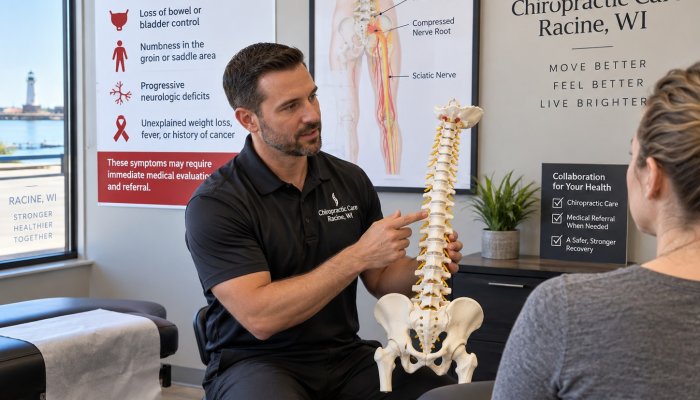
A handful of signs move us from "let's start with conservative care" to "let's get imaging and bring in another provider." The most common one is progressive weakness, meaning strength that's getting worse over time rather than holding steady or slowly improving. We also watch for numbness in the groin or inner thighs, called saddle anesthesia, and any new problems with bowel or bladder control. Together, those last two can point to cauda equina syndrome, a rare but genuine medical emergency that needs same-day evaluation, not a wait-and-see approach.
Short of those, there's a more common scenario: conservative care simply isn't moving things in the right direction. If we're roughly two to four weeks in without meaningful improvement, that's typically when we move toward imaging and a referral, alongside continued care rather than instead of it.
Common Signs
- Pain, numbness, or tingling running from the low back or buttock down the leg
- Progressive weakness, particularly affecting the foot or leg
- Numbness in the groin or inner thighs
- New or worsening problems with bowel or bladder control
What Referral Actually Looks Like
Referring out doesn't mean we've given up on being part of your care. Depending on what's going on, it usually means bringing in an orthopedic provider alongside what we're already doing, rather than stepping aside entirely. One recent patient of ours is a good example of this in practice: his low back pain progressed into leg weakness, and once that showed up, we referred him to orthopedics for co-management while continuing chiropractic care ourselves rather than waiting to see if things resolved on their own. We go through that case in full on our main sciatica page.
Why We're Upfront About This
We'd rather tell you when something is outside what we treat well than try to manage everything ourselves. A practice that never refers anyone out usually isn't being fully honest about the limits of any single approach, and sciatica with real neurological involvement is exactly the kind of thing that benefits from more than one set of eyes on it.
What This Looks Like Day to Day
Depending on the case, ongoing conservative care alongside a referral can still include:
- Chiropractic adjustments
- Class IV laser therapy, mainly to help bring down inflammation
- Dry needling, which Dr. Marissa Kaul is certified in, for muscle spasm and pain control
- Shockwave therapy (ESWT), which we tend to reach for on more chronic cases to help restart the healing process
- Exercise therapy, to help rebuild strength and restore movement as symptoms allow
- Electrical muscle stimulation (EMS), for additional pain control
Not every case needs all six, and what we recommend, referral included, depends on what the exam and ongoing progress actually show.
What You Can Do at Home
Between visits, the emphasis is usually on staying as active as pain allows rather than resting completely, along with specific movement work when it's appropriate for the case. If any of the signs above show up, that's a reason to call us or seek medical attention rather than waiting on home care to catch up.
Frequently Asked Questions
If you refer me out, does that mean you can't help me?
Not at all. Referral usually means bringing in another provider alongside what we're already doing, since some cases genuinely benefit from more than one type of care working together.
What is cauda equina syndrome?
It's a rare but serious condition where the bundle of nerves at the bottom of the spinal cord gets compressed, and it can cause permanent damage if it isn't treated quickly. The warning signs are numbness in the groin or inner thighs and new problems with bowel or bladder control, and it needs same-day medical evaluation.
If I have some numbness, does that automatically mean I need surgery?
No. Numbness alone doesn't automatically mean surgery is necessary. Progressive weakness, or numbness alongside the other red-flag signs, is what typically moves the conversation toward imaging and a specialist opinion.
Can I still see a chiropractor while I'm also seeing a specialist?
Usually, yes. Co-management, where we continue conservative care alongside another provider, is common and often the right approach rather than an either-or choice.
Ready to Get Checked Out?
Daniels Chiropractic has taken care of Racine families since 1948, with more than 800 patient reviews and a 5.0 rating on Google. If you are in pain today, we try to get you in the same day.
Call or text (262) 638-9999, or schedule online below.