
Sciatica or Something Else? Ruling Out Stenosis and Glute Referral Pain
By John Daniels, DC, CCSP — Daniels Chiropractic, Racine, WI
Not every pain running down the leg is sciatica, even though that's usually the first word people reach for. A fair number of cases turn out to be spinal stenosis or referred pain from the gluteus medius or minimus, and telling these apart matters, since they don't always respond to the same approach. This post covers how we sort that out. For the broader picture on sciatica itself, our main sciatica page is the place to start, and if you're wondering whether "sciatica" and "herniated disc" mean the same thing, we covered that separately in Sciatica vs. Herniated Disc.
Why the Differential Matters
True sciatica, spinal stenosis, and gluteal referral pain can all produce pain running from the low back or hip down into the leg, which is exactly why they get confused with each other so often. Treatment overlaps quite a bit across all three, since adjustments, laser, and exercise tend to help regardless. Still, knowing which one is actually driving the symptoms shapes the exam findings we watch, how urgently we consider imaging, and whether dry needling or a different approach makes more sense.
Common Signs
- Pain, numbness, or tingling running from the low back or buttock down the leg
- Symptoms that may be worse with certain positions or activities, depending on the underlying cause
- In some cases, weakness affecting the foot or leg
When to Seek Immediate Medical Attention
Regardless of which of these three turns out to be the cause, there are a few signs that need prompt medical evaluation rather than a wait-and-see approach. The most common one we watch for is progressive weakness, meaning strength that's getting worse rather than holding steady or slowly improving. We also screen for numbness in the groin or inner thighs and any new problems with bowel or bladder control, since those can point to cauda equina syndrome, which is a medical emergency. If conservative care isn't producing improvement over roughly the first two to four weeks, that's typically when we move toward imaging and bring in a referral alongside continued care. More on what that looks like in When Sciatica Needs More Than a Chiropractor.
True Sciatica: Nerve Root Involvement
Classic sciatica follows a fairly specific pattern, since it traces the path of a single irritated nerve root. It usually shows up on one side, tends to follow a defined path down the leg rather than a vague general ache, and can come with numbness, tingling, or a change in reflexes along that specific pattern. Nerve tension tests, like the ones we use in the exam, tend to reproduce the pain when the nerve root is genuinely involved.
Spinal Stenosis
Spinal stenosis happens when the space around the nerves in the spine narrows, which can put pressure on multiple nerve roots rather than just one. It often, though not always, affects both legs to some degree, and it tends to correlate with position: standing and walking frequently make it worse, while sitting or leaning forward, like over a shopping cart, often brings relief. That positional pattern is one of the more useful clues we look for.
Glute Referral Pain (Gluteus Medius or Minimus)
Trigger points or irritation in the gluteus medius or minimus muscles can refer pain down the leg in a way that feels a lot like sciatica to the person experiencing it, even though no nerve root is actually involved. This kind of pain tends to stay more localized to the hip and upper leg rather than tracking a specific nerve pattern all the way down, and it typically doesn't come with the numbness, reflex changes, or weakness that true nerve involvement produces. Pressing on the muscle itself often reproduces the familiar pain, which is a useful clue during the exam.
How We Tell Them Apart
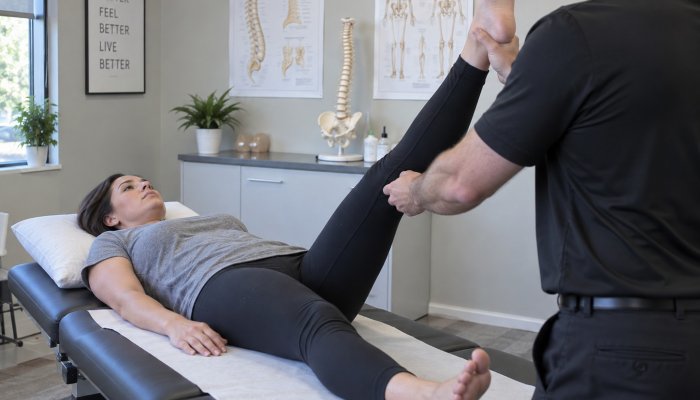
The exam is where this actually gets sorted out. We check reflexes and sensation along specific nerve patterns, use tests like Kemp's test and the slump test to see whether nerve tension reproduces the leg symptoms, and palpate the gluteal muscles for the kind of tenderness that points toward a muscular source instead. Position-related patterns, like whether walking makes it worse and sitting brings relief, add another layer of information. Occasionally the picture stays mixed enough that imaging is the clearest way to settle it, which is part of why we don't treat every case exactly the same way from the start.
How This Gets Treated
What we recommend depends on what the exam finds rather than which label gets used. Depending on the case, that can include:
- Chiropractic adjustments
- Class IV laser therapy, mainly to help bring down inflammation
- Dry needling, which Dr. Marissa Kaul is certified in, for muscle spasm and pain control
- Shockwave therapy (ESWT), which we tend to reach for on more chronic cases to help restart the healing process
- Exercise therapy, to help rebuild strength and restore movement as symptoms allow
- Electrical muscle stimulation (EMS), for additional pain control
Not every case needs all six, and we reassess as you progress rather than committing to a fixed plan upfront.
What You Can Do at Home
Between visits, the emphasis is usually on staying as active as pain allows rather than resting completely, along with specific movement work when it's appropriate for the case. What helps varies quite a bit depending on which of these three is actually going on, so this is really something we tailor once we know what we're dealing with.
Frequently Asked Questions
How can I tell if my leg pain is sciatica or something else?
It's genuinely hard to tell on your own, since all three of these can feel similar day to day. Clues like whether it's one-sided or both, whether walking makes it worse, and whether you notice numbness or weakness along a specific pattern can help, but a proper exam is really what sorts it out.
Does spinal stenosis always affect both legs?
Not always. It's common for stenosis to affect both legs to some degree, but it can also be more pronounced on one side, which is part of why it sometimes gets mistaken for true sciatica.
Can hip or glute pain feel like sciatica?
Yes. Trigger points in the gluteus medius or minimus can refer pain down the leg closely enough to be mistaken for true nerve pain, even though the nerve itself isn't involved.
What tests do you use to check for true sciatica?
We use nerve tension tests like Kemp's test and the slump test, along with reflex and sensation checks along specific nerve patterns. We also palpate the gluteal muscles to rule out a muscular source. Occasionally imaging is needed to settle a mixed picture.
Ready to Get Checked Out?
Daniels Chiropractic has taken care of Racine families since 1948, with more than 800 patient reviews and a 5.0 rating on Google. If you are in pain today, we try to get you in the same day.
Call or text (262) 638-9999, or schedule online below.