By John Daniels, DC, CCSP — Daniels Chiropractic, Racine, WI
We covered the most common cause of sciatica, disc herniation, in Sciatica vs. Herniated Disc, and how to tell true sciatica apart from its look-alikes in Sciatica or Something Else? This post fills in the rest of the picture: the fuller range of things that can actually cause it. For the broader overview, start with our main sciatica.
It Starts With the Nerve Root
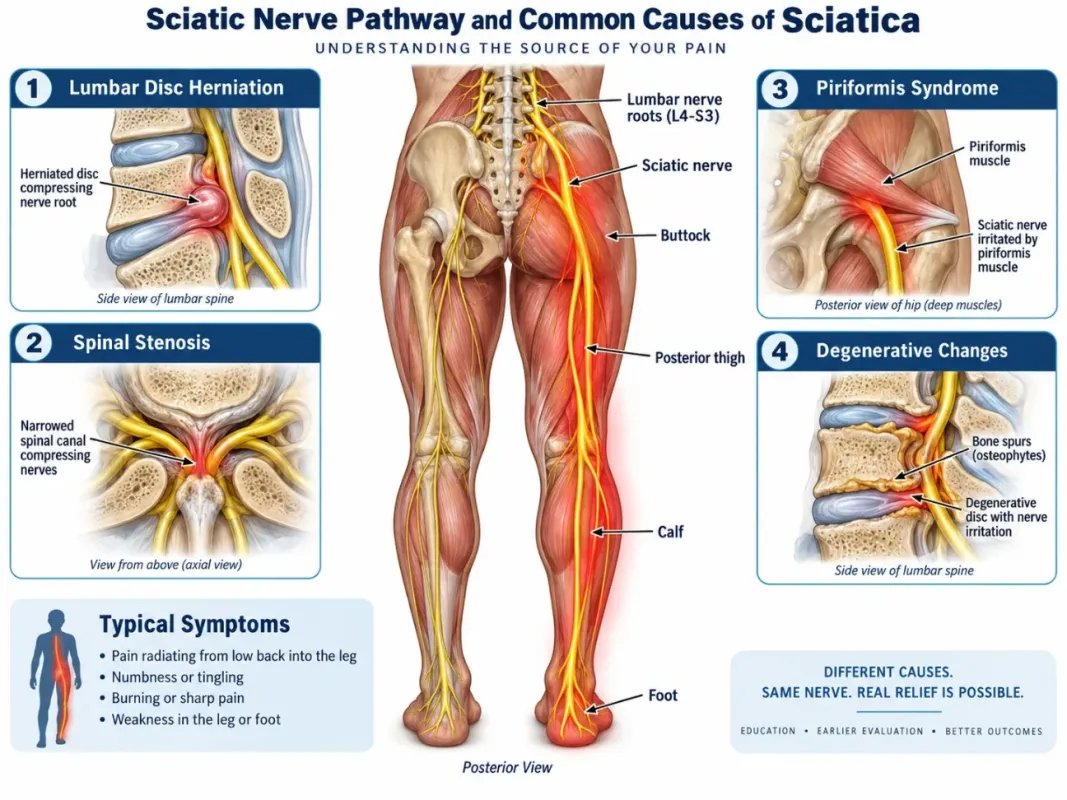
The sciatic nerve is formed from several nerve roots in the lower spine, roughly L4 through S3, that bundle together and run down through the buttock and leg. Sciatica happens whenever something irritates or compresses one of those roots, or occasionally the nerve itself further down its path. Where exactly the problem sits changes which structure is involved, but the leg symptoms tend to follow a recognizable pattern either way.
Common Signs
- Pain, numbness, or tingling running from the low back or buttock down the leg
- Symptoms that often follow one side more than the other
- In more advanced cases, weakness affecting the foot or leg
When to Seek Immediate Medical Attention
Most sciatica responds well to conservative care, but there are a handful of signs we take seriously and refer out for right away. The most common one we watch for is progressive weakness, meaning strength that's getting worse rather than staying the same or slowly improving. We also screen for numbness in the groin or inner thighs and any new problems with bowel or bladder control, since those can point to cauda equina syndrome, which needs emergency evaluation. If conservative care isn't producing improvement over roughly the first two to four weeks, that's typically when we move toward imaging and bring in a referral alongside continued care. More on what that looks like in When Sciatica Needs More Than a Chiropractor.
The Most Common Cause: Disc Herniation
A herniated or bulging disc pressing on a nearby nerve root accounts for the large majority of true sciatica cases. We go into this one in more depth separately, including why it's usually not as alarming as it sounds.
Other Structural Causes
Spinal stenosis, a narrowing of the space around the nerves, can compress a nerve root the same way a disc herniation does, and we've covered how that one tends to present differently. Degenerative disc disease, where discs lose height and hydration with age, can also narrow the space available for a nerve root over time. Less commonly, spondylolisthesis, where one vertebra slips forward relative to the one below it, can pinch a nerve root as well.
Muscle-Related Causes
The sciatic nerve passes close to, and in some people directly through, the piriformis muscle deep in the buttock. When that muscle spasms or tightens, it can irritate the nerve enough to produce symptoms that feel a lot like disc-related sciatica, a pattern sometimes called piriformis syndrome. Referred pain from the gluteus medius or minimus can mimic sciatica too, though that's a muscular referral pattern rather than true nerve involvement, which we go into in more detail elsewhere.
What Increases Risk
Age-related degenerative changes in the spine make disc and joint-related causes more common over time. Occupations involving frequent heavy lifting, twisting, or long periods of driving or sitting tend to increase the load on the lower back. A prior episode also seems to raise the odds of another one, which is part of why the home exercise and movement side of care matters as much as it does.
How This Gets Treated
Since the underlying cause varies, what we recommend depends on what the exam finds rather than a one-size-fits-all protocol. Depending on the case, that can include:
- Chiropractic adjustments
- Class IV laser therapy, mainly to help bring down inflammation
- Dry needling, which Dr. Marissa Kaul is certified in, for muscle spasm and pain control
- Shockwave therapy (ESWT), which we tend to reach for on more chronic cases to help restart the healing process
- Exercise therapy, to help rebuild strength and restore movement as symptoms allow
- Electrical muscle stimulation (EMS), for additional pain control
Not every case needs all six, and we reassess as you progress rather than committing to a fixed plan upfront.
What You Can Do at Home
Between visits, the emphasis is usually on staying as active as pain allows rather than resting completely, along with specific movement work when it's appropriate for the case. What helps varies quite a bit depending on the underlying cause, so this is really something we tailor once we know what we're dealing with.
Frequently Asked Questions
What's the most common cause of sciatica?
A herniated or bulging disc pressing on a nerve root is the most common underlying cause by a wide margin.
Can sitting too much cause sciatica?
Prolonged sitting doesn't usually cause it on its own, but it tends to aggravate an existing issue. It is a common contributing factor alongside other causes, particularly for people in desk jobs or who drive frequently for work.
Is sciatica the same as a pinched nerve?
Broadly, yes. Sciatica describes the symptom pattern that results from a nerve root being irritated or compressed, which is what people usually mean by a pinched nerve in the lower back.
Can sciatica come from a muscle instead of a disc?
Yes. Piriformis syndrome, where a tight or spasming piriformis muscle irritates the sciatic nerve as it passes nearby, can produce symptoms similar to disc-related sciatica even though no disc is involved.
Ready to Get Checked Out?
Daniels Chiropractic has taken care of Racine families since 1948, with more than 800 patient reviews and a 5.0 rating on Google. If you are in pain today, we try to get you in the same day. Most new patients who can be flexible are seen within a day or two.
Call or text (262) 638-9999, or schedule online below.